Tuesday, February 06, 2007


FOUR YEARS AGO TODAY -- BEAVIS AND BUTTHEAD WENT TO THE UN

Hey, man . . . remember that time that Secretary of State dude showed up at the United Nations and was all, like, "Man, these cats in Iraq have, like, a shitload of stuff," and then he was, like, "we got all this evidence that Saddam is lying and shit, and he's a bad guy and he's gotta go,
 and you cats have to help" and the whole world was all like, "Woah, man, that's some heavy trip you're laying on us here, can we, you know, like, think about this a little bit?" And then the President got up in everyone's grill and was like, "Fuck off, man -- we've gotta smoke these people pronto, or else they're gonna start hatin' freedom WMD-style." And then the whole world was kind of looking at each other a little bit and saying, "Hey, Mr. President guy, chill -- take some vitamin C and drink some water, man, 'cuz you're kind of freaking us out here," and the President guy was like,
  "No, man, I'm cool, I'm cool," and then that snarly bald guy with the heart problem was all, like, "grrrrrrrrrr," and we just bugged out and said, "Ok, ok, we believe you a little bit," even if we really didn't, because after all that classy military dude had gotten on TV and swore to God that Iraq had all this shit that -- you know -- scared us and shit?
Remember that?
That was four years ago today.
Monday, February 05, 2007
ISLAMOFASCISM OUT -- FIGHT CLUB IN,
(In a lecture that Kilcullen teaches on counterterrorism at Johns Hopkins, his students watch “Fight Club,” the 1999 satire about anti-capitalist terrorists, to see a radical ideology without an Islamic face.-----After September 11th, Sageman traced the paths of a hundred and seventy-two alienated young Muslims who joined the jihad, and found that the common ground lay not in personal pathology, poverty, or religious belief but in social bonds.)
WARRIOR-INTELLECTUALS RUNNING THE WAR

Gen. David H. Petraeus, the new U.S. commander in Iraq, is assembling a small band of warrior-intellectuals -- including a quirky Australian anthropologist, a Princeton economist who is the son of a former U.S. attorney general and a military expert on the Vietnam War sharply critical of its top commanders -- in an eleventh-hour effort to reverse the downward trend in the Iraq war.
Essentially, the Army is turning the war over to its dissidents, who have criticized the way the service has operated there the past three years, and is letting them try to wage the war their way.
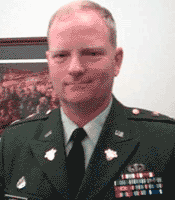
Petraeus's chief economic adviser, Col. Michael J. Meese, will coordinate security and reconstruction efforts, trying to ensure that "build" follows the "clear" and "hold" phases of action. Meese also holds a PhD from Princeton, He is the son of former attorney general Edwin Meese III,
The chief adviser on counterinsurgency operations an outspoken officer in the Australian Army. Lt. Col. David Kilcullen holds a PhD in anthropology, for which he studied Islamic extremism in Indonesia.
Kilcullen has served in Cyprus, Papua New Guinea and East Timor and most recently was chief strategist for the State Department's counterterrorism office, lent by the Australian government. His 2006 essay "Twenty-Eight Articles: Fundamentals of Company-Level Counterinsurgency" was read by Petraeus, who sent it rocketing around the Army via e-mail. Among Kilcullen's dictums: "Rank is nothing: talent is everything" -- a subversive thought in an organization as hierarchical as the U.S. military.
The two most influential members of the brain trust are likely to be Col. Peter R. Mansoor and Col. H.R. McMaster, Both men served on a secret panel whose core conclusion, was that the U.S. government should "go long" in Iraq by shifting from a combat stance to a long-term training-and-advisory effort.
But to make that shift, the review also concluded, the U.S. military might first have to "spike" its presence by about 20,000 to 30,000 troops to curb sectarian violence and improve security in Baghdad. That is almost exactly what the U.S. government hopes to do over the next eight months.
Mansoor, who commanded a brigade of the 1st Armored Division in Baghdad in 2003-04, received a PhD at Ohio State for a dissertation on how U.S. Army infantry divisions were developed during World War II. He will be Petraeus's executive officer in Baghdad, a key figure in implementing the general's decisions.
McMaster's command of the 3rd Armored Cavalry Regiment in northwestern Iraq in 2005-06 provided one of the few bright spots for the U.S. military in Iraq over that year. In a patiently executed campaign, he took back the city of Tall Afar from a terrorist group, and he was so successful that Bush dedicated much of a speech to the operation. McMaster, author of the well-received book "Dereliction of Duty," about the failures of the Joint Chiefs of Staff during the Vietnam War, is expected to operate for Petraeus as a long-distance adviser on strategy. He is based this year at the International Institute for Strategic Studies, a London think tank, but is likely to visit Iraq every month or two, according to a top U.S. military officer.
Lt. Col. Douglas A. Ollivant caught Petraeus's eye last year by winning first prize in an Army "counterinsurgency writing" competition, sponsored by the general, with an essay that scorned the U.S. military's reliance in Iraq on big "forward operating bases." "Having a fortress mentality simply isolates the counterinsurgent from the fight," he wrote.
Ollivant, a veteran of battles in Najaf and Fallujah who earned a political science PhD studying Thomas Jefferson, argued that U.S. forces should instead operate from patrol bases shared with Iraqi military and police units. That is exactly what Petraeus plans to do in the coming months in Baghdad, setting up about three dozen such outposts across the city -- which isn't surprising, considering Ollivant has become a top planner for the U.S. military in Baghdad.

Another adviser will be Ahmed S. Hashim, a professor of strategy at the Naval War College who served as a military intelligence officer in Iraq and then wrote a book sharply critical of how the U.S. military has operated there. Hashim, who holds a PhD from MIT, concluded his critique by arguing that the best course would be to partition the country along ethnic and sectarian lines.s
article here
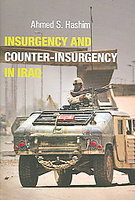
(See Lt.Gen Wm.E.Odom reference here) "For anyone who doubts that the Vietnam case is instructive for understanding the Iraqi case, I recommend Ahmed S. Hashim's recent book, Insurgency and Counterinsurgency in Iraq. A fluent Arab linguist and a reserve US Army colonel, who has served a year in Iraq and visited it several other times, Hashim offers a textured study that struck me again and again as a re-run of an old movie, especially where it concerned US training of Iraqi forces."
Kilcullen, the counterinsurgency adviser, wrote recently on the Web site Small Wars Journal, "All that the new strategy can do is give us a fighting chance of success, and it certainly does give us that."
From the Packard Article
Kilcullen’s heroes are soldier-intellectuals, both real (T. E. Lawrence) and fictional (Robert Jordan, the flinty, self-reliant schoolteacher turned guerrilla who is the protagonist of Hemingway’s “For Whom the Bell Tolls”)
Kilcullen redefined the war on terror as a “global counterinsurgency.” The change in terminology has large implications. A terrorist is “a kook in a room,” Kilcullen told me, and beyond persuasion; an insurgent has a mass base whose support can be won or lost through politics
Kilcullen's good friend and anthropologist and Pentagon consultant named Montgomery McFate. It is her “evangelical mission” to get the Department of Defense to understand the importance of “cultural knowledge.” When I asked “Because I’m engaged in a massive act of rebellion against my hippie parents.”
McFate grew up in the sixties on a communal houseboat in Marin County, California. Her parents were friends with Jack Kerouac and Lawrence Ferlinghetti, and one of her schoolmates was the daughter of Jefferson Airplane’s Grace Slick and Paul Kantner. Like Kilcullen, she was drawn to the study of human conflict and also its reality: at Yale, where she received a doctorate, her dissertation was based on several years she spent living among supporters of the Irish Republican Army and then among British counterinsurgents. In Northern Ireland, McFate discovered something very like what Kilcullen found in West Java: insurgency runs in families and social networks, held together by persistent cultural narratives
By speaking of Saddam Hussein, the Sunni insurgency in Iraq, the Taliban, the Iranian government, Hezbollah, and Al Qaeda in terms of one big war, Administration officials and ideologues have made Osama bin Laden’s job much easier. “You don’t play to the enemy’s global information strategy of making it all one fight,” Kilcullen said. He pointedly avoided describing this as the Administration’s approach. “You say, ‘Actually, there are sixty different groups in sixty different countries who all have different objectives. Let’s not talk about bin Laden’s objectives—let’s talk about your objectives.
Kilcullen’s thinking is informed by some of the key texts of Cold War social science, such as Eric Hoffer’s “The True Believer,” which analyzed the conversion of frustrated individuals into members of fanatical mass movements, and Philip Selznick’s “The Organizational Weapon: A Study of Bolshevik Strategy and Tactics,” which described how Communists subverted existing social groups and institutions like trade unions. To these older theoretical guides he adds two recent studies of radical Islam: “Globalized Islam,” by the French scholar Olivier Roy, and “Understanding Terror Networks,” by Marc Sageman, an American forensic psychiatrist and former covert operator with the mujahideen in Afghanistan. After September 11th, Sageman traced the paths of a hundred and seventy-two alienated young Muslims who joined the jihad, and found that the common ground lay not in personal pathology, poverty, or religious belief but in social bonds. Roy sees the rise of “neo-fundamentalism” among Western Muslims as a new identity movement shaped by its response to globalization. In the margin of a section of Roy’s book called “Is Jihad Closer to Marx Than to the Koran?” Kilcullen noted, “If Islamism is the new leftism, then the strategies and techniques used to counter Marxist subversion during the Cold War may have direct or indirect relevance to combating Al Qaeda-sponsored subversion.”
WARRIOR-INTELLECTUALS RUNNING THE WAR
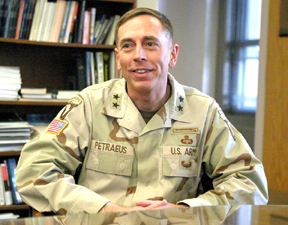
Gen. David H. Petraeus, the new U.S. commander in Iraq, is assembling a small band of warrior-intellectuals -- including a quirky Australian anthropologist, a Princeton economist who is the son of a former U.S. attorney general and a military expert on the Vietnam War sharply critical of its top commanders -- in an eleventh-hour effort to reverse the downward trend in the Iraq war.
Essentially, the Army is turning the war over to its dissidents, who have criticized the way the service has operated there the past three years, and is letting them try to wage the war their way.

Petraeus's chief economic adviser, Col. Michael J. Meese, will coordinate security and reconstruction efforts, trying to ensure that "build" follows the "clear" and "hold" phases of action. Meese also holds a PhD from Princeton, He is the son of former attorney general Edwin Meese III,
The chief adviser on counterinsurgency operations an outspoken officer in the Australian Army. Lt. Col. David Kilcullen holds a PhD in anthropology, for which he studied Islamic extremism in Indonesia.
Kilcullen has served in Cyprus, Papua New Guinea and East Timor and most recently was chief strategist for the State Department's counterterrorism office, lent by the Australian government. His 2006 essay "Twenty-Eight Articles: Fundamentals of Company-Level Counterinsurgency" was read by Petraeus, who sent it rocketing around the Army via e-mail. Among Kilcullen's dictums: "Rank is nothing: talent is everything" -- a subversive thought in an organization as hierarchical as the U.S. military.
The two most influential members of the brain trust are likely to be Col. Peter R. Mansoor and Col. H.R. McMaster, Both men served on a secret panel whose core conclusion, was that the U.S. government should "go long" in Iraq by shifting from a combat stance to a long-term training-and-advisory effort.
But to make that shift, the review also concluded, the U.S. military might first have to "spike" its presence by about 20,000 to 30,000 troops to curb sectarian violence and improve security in Baghdad. That is almost exactly what the U.S. government hopes to do over the next eight months.
Mansoor, who commanded a brigade of the 1st Armored Division in Baghdad in 2003-04, received a PhD at Ohio State for a dissertation on how U.S. Army infantry divisions were developed during World War II. He will be Petraeus's executive officer in Baghdad, a key figure in implementing the general's decisions.
McMaster's command of the 3rd Armored Cavalry Regiment in northwestern Iraq in 2005-06 provided one of the few bright spots for the U.S. military in Iraq over that year. In a patiently executed campaign, he took back the city of Tall Afar from a terrorist group, and he was so successful that Bush dedicated much of a speech to the operation. McMaster, author of the well-received book "Dereliction of Duty," about the failures of the Joint Chiefs of Staff during the Vietnam War, is expected to operate for Petraeus as a long-distance adviser on strategy. He is based this year at the International Institute for Strategic Studies, a London think tank, but is likely to visit Iraq every month or two, according to a top U.S. military officer.
Lt. Col. Douglas A. Ollivant caught Petraeus's eye last year by winning first prize in an Army "counterinsurgency writing" competition, sponsored by the general, with an essay that scorned the U.S. military's reliance in Iraq on big "forward operating bases." "Having a fortress mentality simply isolates the counterinsurgent from the fight," he wrote.
Ollivant, a veteran of battles in Najaf and Fallujah who earned a political science PhD studying Thomas Jefferson, argued that U.S. forces should instead operate from patrol bases shared with Iraqi military and police units. That is exactly what Petraeus plans to do in the coming months in Baghdad, setting up about three dozen such outposts across the city -- which isn't surprising, considering Ollivant has become a top planner for the U.S. military in Baghdad.
Another adviser will be Ahmed S. Hashim, a professor of strategy at the Naval War College who served as a military intelligence officer in Iraq and then wrote a book sharply critical of how the U.S. military has operated there. Hashim, who holds a PhD from MIT, concluded his critique by arguing that the best course would be to partition the country along ethnic and sectarian lines.s
article here
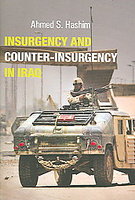
(See Lt.Gen Wm.E.Odom reference here) "For anyone who doubts that the Vietnam case is instructive for understanding the Iraqi case, I recommend Ahmed S. Hashim's recent book, Insurgency and Counterinsurgency in Iraq. A fluent Arab linguist and a reserve US Army colonel, who has served a year in Iraq and visited it several other times, Hashim offers a textured study that struck me again and again as a re-run of an old movie, especially where it concerned US training of Iraqi forces."
Kilcullen, the counterinsurgency adviser, wrote recently on the Web site Small Wars Journal, "All that the new strategy can do is give us a fighting chance of success, and it certainly does give us that."
From the Packard Article
Kilcullen’s heroes are soldier-intellectuals, both real (T. E. Lawrence) and fictional (Robert Jordan, the flinty, self-reliant schoolteacher turned guerrilla who is the protagonist of Hemingway’s “For Whom the Bell Tolls”)
Kilcullen redefined the war on terror as a “global counterinsurgency.” The change in terminology has large implications. A terrorist is “a kook in a room,” Kilcullen told me, and beyond persuasion; an insurgent has a mass base whose support can be won or lost through politics
Kilcullen's good friend and anthropologist and Pentagon consultant named Montgomery McFate. It is her “evangelical mission” to get the Department of Defense to understand the importance of “cultural knowledge.” When I asked “Because I’m engaged in a massive act of rebellion against my hippie parents.”
McFate grew up in the sixties on a communal houseboat in Marin County, California. Her parents were friends with Jack Kerouac and Lawrence Ferlinghetti, and one of her schoolmates was the daughter of Jefferson Airplane’s Grace Slick and Paul Kantner. Like Kilcullen, she was drawn to the study of human conflict and also its reality: at Yale, where she received a doctorate, her dissertation was based on several years she spent living among supporters of the Irish Republican Army and then among British counterinsurgents. In Northern Ireland, McFate discovered something very like what Kilcullen found in West Java: insurgency runs in families and social networks, held together by persistent cultural narratives
By speaking of Saddam Hussein, the Sunni insurgency in Iraq, the Taliban, the Iranian government, Hezbollah, and Al Qaeda in terms of one big war, Administration officials and ideologues have made Osama bin Laden’s job much easier. “You don’t play to the enemy’s global information strategy of making it all one fight,” Kilcullen said. He pointedly avoided describing this as the Administration’s approach. “You say, ‘Actually, there are sixty different groups in sixty different countries who all have different objectives. Let’s not talk about bin Laden’s objectives—let’s talk about your objectives.
Kilcullen’s thinking is informed by some of the key texts of Cold War social science, such as Eric Hoffer’s “The True Believer,” which analyzed the conversion of frustrated individuals into members of fanatical mass movements, and Philip Selznick’s “The Organizational Weapon: A Study of Bolshevik Strategy and Tactics,” which described how Communists subverted existing social groups and institutions like trade unions. To these older theoretical guides he adds two recent studies of radical Islam: “Globalized Islam,” by the French scholar Olivier Roy, and “Understanding Terror Networks,” by Marc Sageman, an American forensic psychiatrist and former covert operator with the mujahideen in Afghanistan. After September 11th, Sageman traced the paths of a hundred and seventy-two alienated young Muslims who joined the jihad, and found that the common ground lay not in personal pathology, poverty, or religious belief but in social bonds. Roy sees the rise of “neo-fundamentalism” among Western Muslims as a new identity movement shaped by its response to globalization. In the margin of a section of Roy’s book called “Is Jihad Closer to Marx Than to the Koran?” Kilcullen noted, “If Islamism is the new leftism, then the strategies and techniques used to counter Marxist subversion during the Cold War may have direct or indirect relevance to combating Al Qaeda-sponsored subversion.”
HUGO SAYS BUSH IS MORE DANGEROUS THAN A MONKEY WITH A RAZOR BLADE

In the lexicon of political insults it will take some beating. Already known for his somewhat colourful use of language Venezuelan president Hugo Chávez has probably written himself into the history books for a new sidewipe at his US counterpart George Bush.
In the latest salvo in the war of words between the two countries Mr Chávez described Mr Bush as "evil," a "criminal" but then added that he was "more dangerous than a monkey with a razor blade".

The comment came during a news conference in Caracas in which Mr Chávez responded to accusations made earlier this week by Mr Bush that he was "undermining ... democratic institutions" by the recent passage of a controversial enabling law to allow for government by decree.

Referring to the war in Iraq, Mr Chávez said that both Mr Bush and John Negroponte, the US director of national intelligence, should be tried for "war crimes ... the two of them are criminals. They should be tried and thrown in prison for the rest of their days." He added: "I pray to God for the people of the United States. I hope they're capable of liberating themselves from the tyranny they have. Who would be the greater fascist - Hitler or Bush? They might end up in a draw."
YOU MIGHT BE GOING DOWN THE TOILET IF...

You know your empire’s crumbling when the folks who are gearing up their empire to replace yours start blowing up satellites in space. And then they don’t bother to return your phone calls when you ring up to ask why.
You know your empire’s crumbling when those same folks are cutting deals left, right and center across Asia, Latin America and Africa, while you, your lousy terms, and your arrogant attitude are no longer welcome.
You know your empire’s crumbling when you’re spending your grandchildren’s money like a drunken sailor, and letting your soon-to-be rivals finance your little splurge (i.e., letting them own your country).
You know your empire’s crumbling when it’s considered an achievement to pretend that you’ve halved the rate at which you’re adding to the massive mountain of debt you’ve already accumulated.
You know your empire’s crumbling when you weaken your currency until it looks as anemic as a Paris runway model, and you’re still setting record trade deficits. (Hint: Because you’re not making anything anymore.)
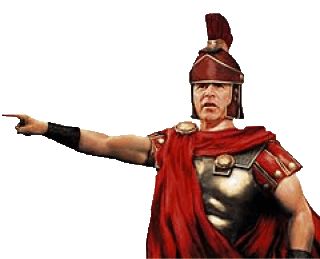
You know your empire’s crumbling when “the little brown ones” (thank you George H.W. Bush – certainly not me – for that lovely expression) in country after country of “your backyard” blow you off and proudly elect anti-imperialist leftist governments.
You know your empire’s crumbling when you can’t topple those governments and replace them with nice puppet regimes – like in the good old days – even if you wanted to. And you badly want to.
You know your empire’s crumbling when one of their leaders comes to the United Nations and makes fun of your emperor, calling him the devil, and joking about smelling sulphur where he just stood. And though a few folks cringe, everybody laughs.
You know your empire’s crumbling when just about your entire military land force is tied up in a worse-than-useless war launched on the basis of complete fabrications, that every day is actually making you less – not more – secure from external threat.
You know your empire’s crumbling when almost half the soldiers in that war are high-paid mercenaries, and you don’t dare institute a draft.

You know your empire’s crumbling when you send soldiers into war with two weeks training and a lack of armor, and then you keep them there for three, four and five rotations.
You know your empire’s crumbling when a member of the Axis of Evil can test missiles and explode nuclear warheads, and all you can do about it is mumble some pathetic warnings about how they better not do that again or there will be consequences.
You know your empire’s crumbling when you even think that there is an Axis of Evil.
You know your empire’s crumbling when a rag-tag military hodge-podge of irregulars has you pinned down in an endless fight you can’t win, but also can’t lose.
You know your empire’s crumbling when you're too dumb to even ban Humvees as a first step toward ending your dependency on a foreign-owned crucial resource.
You know your empire’s crumbling when you trade your prior moral leadership on human rights issues for global disgust at your torture, ‘extraordinary rendition’ (a.k.a. kidnaping for torture) and the dismantling of nine centuries worth of civil liberties progress.
You know your empire’s crumbling when you blow off international law that you once helped create, and undermine the institutions of international governance that you once helped build.
You know your empire’s crumbling when opinion polls confirm that every month you’re more and more despised throughout the world.
You know your empire’s crumbling when you can’t even pull off the hanging of a tin-pot murderous former dictator without turning him into a hero.
You know your empire’s crumbling when you’re the richest country in the world, but nearly 50 million of your people don’t have basic health care coverage.
You know your empire’s crumbling when the World Health Organization ranks your healthcare system 37th ‘best’ in the world, just above Slovenia, and just below Costa Rica. (And far below Colombia, Cyprus, Saudi Arabia and Morocco.)
You know your empire’s crumbling when instead of making it easier for citizens to obtain a higher education, you’re making it harder and more expensive.
You know your empire’s crumbling when your government gives tax breaks to industries as a reward for exporting your jobs elsewhere.
You know your empire’s crumbling when the so-called ‘opposition’ party can’t even turn that obscenity into a viable campaign theme and use it to clobber the worst emperor in your history.
You know your empire’s crumbling when your middle class has been stagnant for three decades, while the wealth of the hyper-rich continues to climb through the roof.
You know your empire’s crumbling when your reaction to that is to exacerbate the problem by enacting tax policies that massively increase further still the gap between the rich and the rest.
You know your empire’s crumbling when the predatory class has taken over your government and is stripping the country of everything not bolted down to the floor. And then it sells the floor itself, as well, to your rivals.
You know your empire’s crumbling when you're spending tens of billions of dollars you don’t own on new nuclear warheads and space weapons that don’t work, to be used against an enemy you don’t have.
You know your empire’s crumbling when one of your cities drowns and your government does next to nothing before, during and after.
You know your empire’s crumbling when a massive environmental nightmare is looming around the corner, and your emperor not only ignores it, but claims it isn’t real while taking steps to exacerbate it.
You know your empire’s crumbling when your emperor is warned by a CIA briefer of an imminent terrorist attack of vast proportions, and responds by remaining on vacation and dismissing the briefer with the words: “All right. You've covered your ass, now.”
You know your empire’s crumbling when the same emperor drops everything to fly across the country from his vacation home in order to sign a bill intervening on the wrong side of a personal medical drama involving a single family.
You know your empire’s crumbling when gays and immigrants are used as diversionary issues to keep people from thinking about the pillaging of their country and their wallets actually taking place. And it works.
You know your empire’s crumbling when people are getting more religious and less scientific, not the other way around.
You know your empire’s crumbling when your political leaders start to be chosen by dynastic rules of succession.
And you especially know your empire’s crumbling when the most idiotic child of one of the least accomplished leaders in its history is not only crowned as the next emperor, but is even revered for a time by most of the public as a great one.
Sunday, February 04, 2007

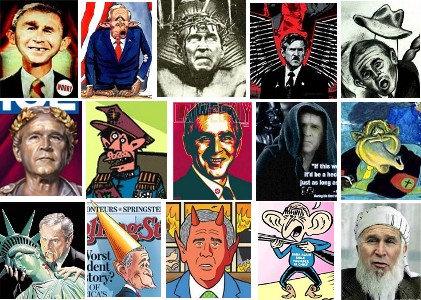
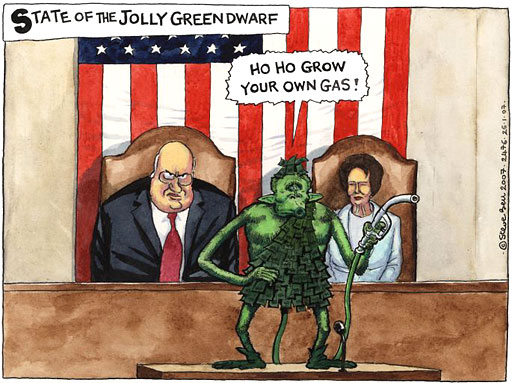
From top, left to right: Brian Stauffer, Steve Bell, Ministry CD, Skrupel / Phobia split CD, Sue Coe, Village Voice, Ted Rall, LA Weekly, Truthdig, Martin Rowson, Alex Ross, Robert Grossman, Tom Tomorrow, Ward Sutton, Tariq Ali book.
Friday, February 02, 2007
ENABLING LAWS AND THE BOLIVIAN REVOLUTION
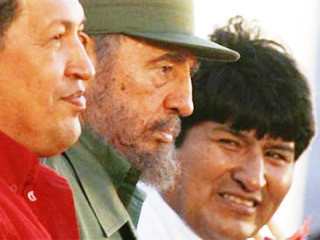
Why Aren't You in a Hurry, Comrade?
by Michael A. Lebowitz
"What's the rationale for allowing Chavez to govern by decree?"
A single party, rule by decree -- isn't this the road to Stalinism and to the gulag?
...unified party of the revolution .... with Chavez's stress upon the need to build it from below and to make it the most democratic party in Venezuela's history...
..people active in communal councils in two Caracas neighbourhoods (one extremely poor)...(with)... frustration and anger of so many with local and ministry officials who were holding back change --
-- they agree with the need for speed...they are less interested in democracy as process than in democracy in practice.
...in a country with an enormous social debt, where people have basic needs for sewers, electricity, water, jobs, housing, etc. and where they are being encouraged to take things into their hands through communal councils, cooperatives, and other forms of collective self-activity --
and where everywhere they come up against the long-standing patterns of bureaucracy, corruption, and clientelism -- should we be surprised that the people are impatient?
The real question that needs to be posed is one to traditional Venezuelan intellectuals and their counterparts abroad: why aren't you in a hurry, comrade?
Monday, January 29, 2007
LAYKOFF ALERT!! --- A DEMOCRAT MAKES A "FRAME"
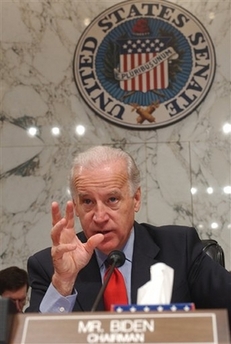
Biden: 'Failed policy' emboldens enemy
By HOPE YEN, Associated Press Writer Sun Jan 28, 3:28 PM ET
WASHINGTON -
The Senate Foreign Relations Committee chairman on Sunday dismissed criticism a resolution opposing a troop buildup in
Iraq would embolden the enemy and estimated perhaps only 20 senators believe
President Bush "is headed in the right direction."
"It's not the American people or the U.S. Congress who are emboldening the enemy," said Sen. Joe Biden, D-Del., and White House hopeful in 2008. "It's the failed policy of this president — going to war without a strategy, going to war prematurely."
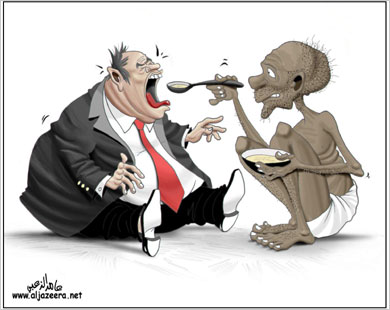
Chavez: “Capitalism must be transcended”
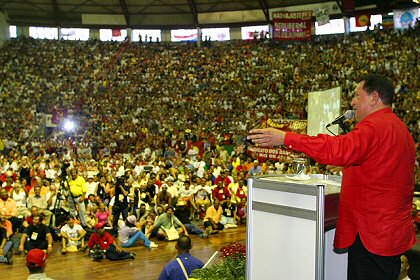
Redacted from an article by Alan Woods
In Jan, 2005, Venezuelan President Chavez gave a speech at the Gigantinho Stadium at the closing session of the World Social Forum in Porto Alegre, Brazil. In this speech, President Chavez gave further indications of the direction in which the Bolivarian Revolution is moving. This speech, reported in Venezuelanalysis.com (Caracas, Jan 30, 2005), deserves to be studied by every conscious worker and revolutionary youth.
The Bolivarian Revolution started out as a national democratic revolution, aimed at freeing the people of Venezuela from the rule of a corrupt and degenerate oligarchy that acted as the local agency of imperialism.
The recent nationalisation of Venepal and decree on agrarian reform marked a clear turn of the Revolution in the direction of a decisive confrontation with its enemies.
U.S. imperialism is not invincible.
The aim of the Bolivarian Revolution is to spread to every country in Latin America – and beyond.
The satellite TV network TeleSur, “which will allow us to tell our people’s reality in our own words.”
“We must start talking again about equality. The U.S. government talks about freedom and liberty, but never about equality.

The U.S. people, with whom we share dreams and ideals, must free themselves... A country of heroes, dreamers, and fighters, the people of Martin Luther King, and Cesar Chavez.”
He paid tribute to the cooperation with Cuba, which, along with several Central American countries, receives Venezuelan oil at below market prices, in exchange for assistance in healthcare, education, agriculture and other areas. And that Venezuela has used a Cuban literacy method approved by UNESCO that has allowed more than 1.3 million Venezuelans learn how to read and write. He said Venezuela is using Cuban vaccines, which now allow poor children to be vaccinated against diseases such as hepatitis.
“When imperialism feels weak, it resorts to brute force. The attacks on Venezuela are a sign of weakness, ideological weakness. Nowadays almost nobody defends neoliberalism. Up until three years ago, just Fidel [Castro] and I raised those criticisms at Presidential meetings. We felt lonely, as if we infiltrated those meetings.”
“Just look at the internal repression inside the United States, the Patriot Act, which is a repressive law against U.S. citizens.
“because the peoples are not going to accept in peace impositions such as neoliberalism or such as colonialism.”
“Capitalism must be transcended”
the need to pass from the national democratic tasks to the socialist transformation of society:
It is necessary to transcend capitalism. But capitalism can’t be transcended from within capitalism itself, but through socialism, true socialism, with equality and justice. But I’m also convinced that it is possible to do it under democracy, but not in the type of democracy being imposed from Washington,” Chavez said.
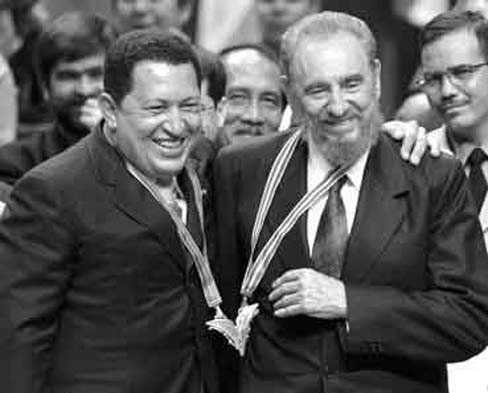
To succeed it makes deep inroads on private property, unless it takes the decisive step of expropriating the landlords, bankers and capitalists.
“We have to re-invent socialism. It can’t be the kind of socialism that we saw in the Soviet Union, but it will emerge as we develop new systems that are built on cooperation, not competition,” he added.
“It is impossible, within the framework of the capitalist system to solve the grave problems of poverty of the majority of the world’s population. a new type of socialism, a humanist one, which puts humans and not machines or the state ahead of everything.
Socialism is democratic or it is nothing. From the very beginning, the control and administration of industry, society and the state must be in the hands of the working class itself. That is the only way to prevent the formation of a bureaucracy – that abominable cancer on the body of the workers’ state – and to ensure that the masses are actively identified with the Revolution from the start. The active participation of the masses is the first rule of socialism.

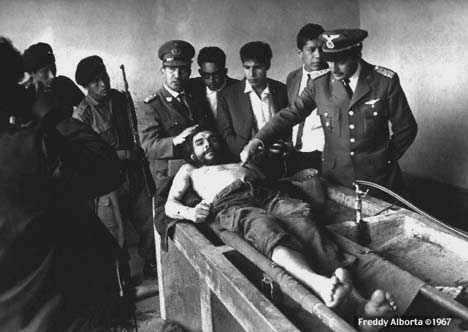
Che’s methods are not applicable. “That thesis of one, two, or three Vietnams, did not work, Che’s aim of spreading the Revolution to Latin America was correct and necessary. But unfortunately the tactic he adopted was mistaken.
the tactic of guerrilla war has led to one defeat after another in Latin America. The Cuban Revolution took the US imperialists by surprise. But they learned the lessons and applied them. As a result, every time a “foco” appeared, they immediately crushed it before it could develop further – as we saw with the tragic fate of Che Guevara in Bolivia.
But it makes little sense in Latin America where the big majority of the population lives in towns and cities.
The great advantage of the Venezuelan Revolution is that it is a mainly urban revolution (though with important support in the peasantry) based on the active movement of the masses, in particular the working class and its natural allies, the urban poor, the unemployed, the revolutionary youth, the women and the progressive intelligentsia.
Parliamentary and extra-parliamentary struggle
Pay careful attention to the parliamentary struggle. Skilfully combined democratic slogans with the economic and social demands of the proletariat, linking them to the idea of taking power. That is the only way to build a mass base, to mobilise the masses and thus to create the objective conditions for a revolutionary overturn. There is no other way.
The Bolivarian Revolution began on the electoral plane and has dealt one blow after another against the counterrevolutionaries, By this means it has rallied the masses behind it. It is a dialectical law that the struggle in parliament must eventually be resolved outside parliament. Reformists and parliamentary cretins do not understand this. That is why they always lead the movement to defeat – as in Chile. If the pro-bourgeois reformist wing of the Bolivarian Movement wins, the same fate awaits the people of Venezuela.
However, the pro-bourgeois and reformist elements have not yet won. The masses are pressing from below. The workers demand nationalisation of the factories, the peasants want to put an end to landlordism. The Revolution has not ended, as the reformists claim. It has scarcely begun!
mobilising, inspiring and organising millions of oppressed people who were never organised before. That is a tremendous achievement!
The masses in Venezuela have developed a very keen sense of democracy. They will not tolerate bureaucracy and autocratic methods. This is the greatest guarantee against the danger of a future totalitarian state. It will be impossible (or at least very difficult) to impose a Stalinist dictatorship under such conditions.
quoted by the great Russian revolutionary Leon Trotsky, that “each revolution needs the whip of the counterrevolution to advance.” He listed actions by the opposition and the U.S. government to drive him out of power. “But we resisted, and now have gone onto the offensive. We recovered our oil industry... In 2004, from the oil industry budget we utilized $4 billion in social investments, education, health, micro-credits, scholarships, and housing, aimed at the poorest of the poor, what neoliberals call waste of money. But that is not a waste of money because it is aimed at empowering the poor so that they can defeat poverty.” He added that “that money before stayed out of Venezuela or just benefited the rich.”
“privatisation is a neoliberal and imperialist plan. Health can’t be privatised because it is a fundamental human right, nor can education, water, electricity and other public services. They can’t be surrendered to private capital that denies the people from their rights.” It is necessary to fight against privatisation. But the real solution is to establish a genuine socialist plan of production under the democratic control and administration of the working class.
The only really reliable point of support for the Bolivarian Revolution is the millions of oppressed workers and peasants of Latin America and the Labour Movement of the whole world. If it shows that it is capable of taking the decisive step of breaking the stranglehold of Capital and ending capitalist slavery once and for all, that passive sympathy will be immediately transformed into militant action. US imperialism would be paralysed and unable to intervene because it would be faced with uprisings everywhere – and a mass movement inside its own borders.
MIDDLE EAST "BIRTHPANGS" NOW CALLED "REALIGNMENT"

Rice's Strategic Reset
By David Ignatius
Friday, January 26, 2007; Page A21
Washington Post
What's America's strategy in the Middle East? Secretary of State Condoleezza Rice this week sketched a new framework based on what she calls the "realignment" of states that want to contain Iran and its radical Muslim proxies...
For explanation go to Missing Links

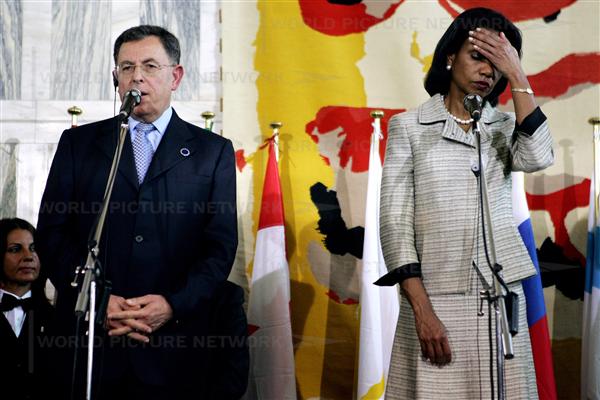
The events in Lebanon last week were an early implementation of the new Rice strategy
Joseph Samaha comments on where Lebanon fits in Condoleeza Rice's new "realignment" strategy, outlined in a WaPo column by David Ignatius yesterday.
- There are the "moderates" (non-democratic) - Saudi Arabia (GCC), Egypt, Jordan, etc.
- There are "extremists" - Iran, Hezbollah, Hamas,
- In the middle are "target administrations" the Iraqis, Palestinians and Lebanese, democracies that need to be helped and supported by the (non-democratic) "moderates" to resist the "extremists",
- Maliki to support the occupation
- Abbas is supposed to topple the elected Hamas government with US arms and funding;
- Lebanon to escalate the general strike into a sectarian confrontation with Hizbullah.
This new policy is the result of the failures of the US in Iraq and of Israel in Lebanon.
- Baker-Hamilton or Kagan (American Enterprise Institute)
- More battleships to the Gulf;
- deployment of Patriot missiles in the region;
- invasion of Somalia;
- provoking Iran;
- cutting off any chance of talks with Syria;
- sharpening the Hamas-Fatah split;
- more troops to Iraq.
Saturday, January 27, 2007
INTERESTING BLOG FROM "HEALING IRAQ"
Friday, January 26, 2007
No Quorum for Months

Iraqi Parliament has failed to reach quorum since October 2006. Understandably, it's hard to attend parliamentary sessions when you live in the Green Zone, or the Rashid Hotel, or Amman, or Dubai, or London. MP Adnan Al-Pachachi, who spoke from Dubai, complained that their salaries can only afford 20 security guards, while they need at least 40 to make it from the Baghdad Airport to the Green Zone. I wonder how many security guards Pachachi would need if he were to venture on the streets of Baghdad, which he probably hasn't seen in decades.
Funny, too, that he would complain about the salary. Iraqi members of parliament receive up to $120,000 in salaries and benefits, or about $10,000 a month, plus the additional salaries of 20 security guards - which most MPs choose to pocket instead. Actually, the first bill Iraqi MPs (of all sects and ethnicities) passed unanimously was the one in which they defined their salaries, privileges and benefits. That session was conveniently closed to the media. Perhaps you should also know that the average salary for a civil servant in Iraq is $150. A day labourer would make less than half of that. And you would be considered quite well-to-do if your salary is $400 or $500.
Shame. And this is what they call a "democratically-elected government."
Meanwhile, Iraqi refugees are piling up in Jordan and Syria, except they are regarded as tourists, since Jordan is worried about the consequences of the word "refugee." Soon, Iraqis might not even have that luxury. I often tell my family to come up with a plan to leave as soon as possible before Syria - the last remaining outlet for Iraqis fresh out of the country - decides to close its borders as well when it becomes too much of a strain.
Here is my post on Iraqis in Jordan when I was in Amman last summer.
No Quorum for Months
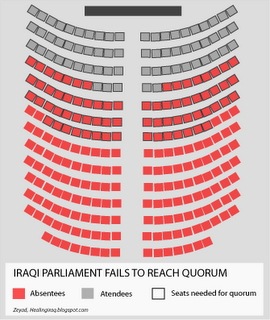
Iraqi Parliament has failed to reach quorum since October 2006. Understandably, it's hard to attend parliamentary sessions when you live in the Green Zone, or the Rashid Hotel, or Amman, or Dubai, or London. MP Adnan Al-Pachachi, who spoke from Dubai, complained that their salaries can only afford 20 security guards, while they need at least 40 to make it from the Baghdad Airport to the Green Zone. I wonder how many security guards Pachachi would need if he were to venture on the streets of Baghdad, which he probably hasn't seen in decades.

Funny, too, that he would complain about the salary. Iraqi members of parliament receive up to $120,000 in salaries and benefits, or about $10,000 a month, plus the additional salaries of 20 security guards - which most MPs choose to pocket instead. Actually, the first bill Iraqi MPs (of all sects and ethnicities) passed unanimously was the one in which they defined their salaries, privileges and benefits. That session was conveniently closed to the media. Perhaps you should also know that the average salary for a civil servant in Iraq is $150. A day labourer would make less than half of that. And you would be considered quite well-to-do if your salary is $400 or $500.
Shame. And this is what they call a "democratically-elected government."
Meanwhile, Iraqi refugees are piling up in Jordan and Syria, except they are regarded as tourists, since Jordan is worried about the consequences of the word "refugee." Soon, Iraqis might not even have that luxury. I often tell my family to come up with a plan to leave as soon as possible before Syria - the last remaining outlet for Iraqis fresh out of the country - decides to close its borders as well when it becomes too much of a strain.
Here is my post on Iraqis in Jordan when I was in Amman last summer.
Friday, January 26, 2007
UNITED FRUIT COMPANY REDUX
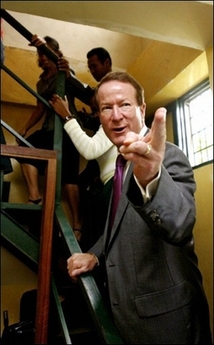
Asked about U.S. policy, Brownfield reiterated that governments have a "sovereign right" to nationalize companies but that they are bound by international obligations to do so "in a transparent and legal way, and to offer fair and quick compensation."
The government plans to nationalize the telecommunications company CA Nacional de Telefonos, or CANTV — whose largest minority shareholder is New York-based Verizon Communications Inc. — and Electricidad de Caracas, owned by Arlington, Virginia-based AES Corp.
"Our hope is that any nationalization be a negotiated process that eventually represents the interests of all parties involved," Brownfield said.

Chavez has said he wants an immediate state takeover of CANTV and will not pay shareholders the international market value. He has said the price paid for the telephone company would take into account debts to workers, pensions and other obligations to the state.
U.S. officials have accused Chavez of becoming increasingly authoritarian and of being a destabilizing force. The Venezuelan leader has repeatedly accused Washington of plotted against him.
Thursday, January 25, 2007
IT'S HARD TO HAVE A CONVERSATION IN A BURNING HOUSE

And I want you to join me not just for the campaign but for a conversation about the future of our country -- about the bold but practical changes we need to overcome six years of Bush administration failures.
PAT BUCHANAN EXPOSES THE HYPOCRISY -- OR THE IDIOCY

"This war," said Bush, "is an ideological struggle. ... To prevail, we must remove the conditions that inspire blind hatred and drove 19 men to get onto airplanes and to come to kill us."
But the "conditions" that drove those 19 men "to come to kill us" is our dominance of their world, our authoritarian allies, and Israel.
They were over here because we are over there.
"What every terrorist fears most is human freedom – societies where men and women make their own choices."
The truth is terrorists do not fear free societies, they flourish in them. The suicide bombers of 9/11, Madrid, and London all plotted their atrocities in free societies. From the Red Brigades, who murdered Italy's Aldo Mori, to the Baader-Meinhoff Gang, who tried to kill Al Haig, to the Basque ETA, the IRA and the Puerto Rican terrorists who tried to assassinate Harry Truman, free societies are where they do their most effective work.
"Free people are not drawn to violent and malignant ideologies,"
During 2006, free Latin peoples brought to power anti-American Leftists Hugo Chávez in Venezuela, Evo Morales in Bolivia, Daniel Ortega in Nicaragua and Rafael Correa in Ecuador, and came close to electing their comrades Ollanta Humala in Peru and Andrés Manuel López-Obrador in Mexico.
In the free elections Bush demanded in Egypt, Lebanon, Palestine and Iraq, the winners were the Muslim Brotherhood, Hezbollah, Hamas and Shi'ite militants with ties to Iran.
If a referendum were held in the Middle East on the proposition of the US military out and Israel gone, how does Bush think it would come out?
"So we advance our security interests by helping moderates, reformers and brave voices for democracy," said Bush.
But how many of those "moderates" – Egypt, Saudi Arabia, Jordan, Morocco, Kuwait, the Gulf States – are ruled "by brave voices for democracy"?
Our Islamist enemies would likely endorse unanimously a Bush call for free elections in all those countries, as elections could not but help advance to greater power, at the expense of our friends, those same Islamist enemies.
"The great question of our day is whether America will help men and women in the Middle East to build free societies," said Bush.
But if we bleed our country to give the men and women of the Middle East the freedom to choose the society they wish to live in, are we sure they will not choose a society where Sharia is law? In liberated Afghanistan, popular sentiment was behind beheading a Muslim who converted to Christianity.
What leads Bush to believe everyone wants to be like us? Is it not ideology?
To characterize "the totalitarian ideology" we confront, Bush quoted Osama bin Laden: "Death is better than living on this Earth with the unbelievers among us."

"Give me liberty or give me death!" said Patrick Henry of the Brits remaining in this country that Brits had founded. "Live free or die!" is the motto of the great state of New Hampshire.
This is the heart of the war we are in. Americans believe in freedom first. Millions of Muslims believe in Islam first – submission to Allah. We decide for us. Do we also decide for them?
DOME OF THE ROCK ON VODKA BOTTLE IN ISRAEL

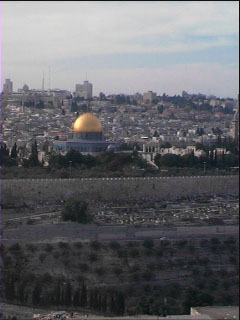
...The Mufti of Jerusalem and Palestine Sheikh Mohammed Hussein condemned the behavior of the Israeli company saying that "the marketing of wine bottles with a picture of the Dome of the Rock, an Islamic shrine in Jerusalem, on them is an Israeli attempt to humiliate Muslims everywhere". He said that "putting a picture of a holy shrine on a bottle of wine which is forbidden in Islam is an insult on Islamic creed and Islamic civilization."
"It is a belligerence on Muslims dignity and passion", he added.
REPORTING LIVE FROM MY OWN ASS --- THIS IS THOMAS FRIEDMAN
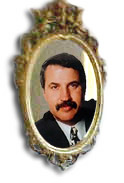
Column can be found here
Thanks Angry Arab News Service
From Friedman's column today: "The brutally honest Syrian-born poet Ali Ahmad Said, known as Adonis, gave an interview from Paris on March 11, 2006, with Dubai TV*, and warned of what’s at stake (translation by Memri): “The Arab individual is no less smart, no less a genius, than anyone else in the world. He can excel — but only outside his society." Really? But Adonis' own career refutes that theory. Adonis excelled but only INSIDE his society. He excelled when he wrote in Syria and Lebanon; but when he went OUTSIDE his society, he never wrote anything memorable.
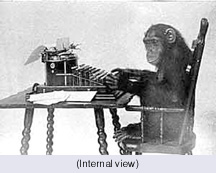
*No. Friedman does not watch Arab TV; and can't understand it even if he watches it. But he can read MEMRI reports..
PS And shouldn't Adonis offer some royalties to the estate of Raphael Patai? I mean, he never offers any observations on Arab society that were not mentioned in The Arab Mind.
From Unclaimed Territory
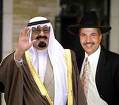
the person who, by far, was most responsible for selling the war to centrists and liberal "hawks" and thereby creating "consensus" support for Bush's war -- Tom Friedman, from his New York Times perch as "the nation's preeminent centrist foreign policy genius."
Friedman is truly one of the most frivolous, dishonest, and morally bankrupt public intellectuals burdening this country. Yet he is, of course, still today, one of the most universally revered figures around, despite -- amazingly enough, I think it's more accurate to say "because of" -- his advocacy of the invasion of Iraq, likely the greatest strategic foreign policy disaster in America's history.
INSURGENCY AND COUNTERINSURGENCY IN IRAQ

More than two years after the U.S. invasion of Iraq, a loosely organized insurgency continues to target American and Coalition soldiers, as well as Iraqi security forces and civilians, with devastating results. In this sobering account of the ongoing violence, Ahmed Hashim, a specialist on Middle Eastern strategic issues and on irregular warfare, reveals the insurgents behind the widespread revolt, their motives, and their tactics. The insurgency, he shows, is not a united movement directed by a leadership with a single ideological vision. Instead, it involves former regime loyalists, Iraqis resentful of foreign occupation, foreign and domestic Islamist extremists, and elements of organized crime. These groups have cooperated with one another in the past and coordinated their attacks; but the alliance between nationalist Iraqi insurgents on the one hand and religious extremists has frayed considerably. The U.S.-led offensive to retake Fallujah in November 2004 and the success of the elections for the Iraqi National Assembly in January 2005 have led more "mainstream" insurgent groups to begin thinking of reinforcing the political arm of their opposition movement and to seek political guarantees for the Sunni Arab community in the new Iraq.
Hashim begins by placing the Iraqi revolt in its historical context. He next profiles the various insurgent groups, detailing their origins, aims, and operational and tactical modi operandi. He concludes with an unusually candid assessment of the successes and failures of the Coalition's counter-insurgency campaign. Looking ahead, Hashim warns that ethnic and sectarian groups may soon be pitted against one another in what will be a fiercely contested fight over who gets what in the new Iraq. Evidence that such a conflict is already developing does not augur well for Iraq's future stability. Both Iraq and the United States must work hard to ensure that slow but steady success over the insurgency is not overshadowed by growing ethno-sectarian animosities as various groups fight one another for the biggest slice of the political and economic pie.
In place of sensational headlines, official triumphalism, and hand-wringing, Insurgency and Counter-insurgency in Iraq offers a clear-eyed analysis of the increasingly complex violence that threatens the very future of Iraq.
About the Author
Ahmed S. Hashim is Professor of Strategic Studies at the U.S. Naval War College. His previous books include Iran: Dilemmas of Dual Containment and Iraq: Sanctions and Beyond, both written with Anthony H. Cordesman.
Lt. General William E. Odom--
For anyone who doubts that the Vietnam case is instructive for understanding the Iraqi case, I recommend Ahmed S. Hashim's recent book, Insurgency and Counterinsurgency in Iraq. A fluent Arab linguist and a reserve US Army colonel, who has served a year in Iraq and visited it several other times, Hashim offers a textured study that struck me again and again as a re-run of an old movie, especially where it concerned US training of Iraqi forces.
Wednesday, January 24, 2007
HUH?
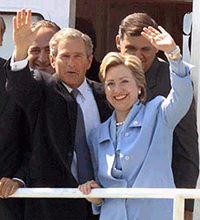

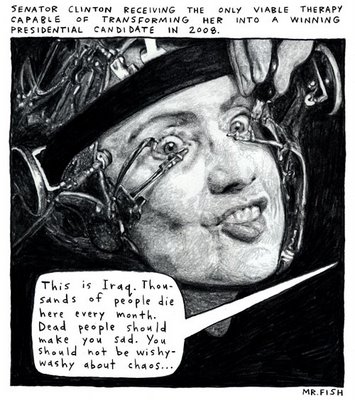
"We know this policy is going forward," said Senator Hillary Rodham Clinton, Democrat of New York. "We know the troops are moving. We know that we're not likely to stop this escalation. But we are going to do everything we can to send a message to our government and the Iraqi government that they had better change, because the enemy we are confronting is adaptable."

And right now, Presidential candidates are tailoring their messages for elite donors, and the rich don't really care about inequality or Iraq. They care first and foremost about preserving the status quo, because in the status quo they are, well, rich. That's a problem, because if your message is targeted towards the top 1% of the country, you're leaving 99% of the country out of the conversation.

But it's very clear that her campaign will be a $500 million attempt to cover for the fact that she has just not been honest or trusthworthy on the most important issue of our time, Iraq. What Jim Webb showed after the State of the Union is that $500M can buy you many things, but it cannot buy you integrity and strength. It can't buy you voter trust. And as the campaign heats up, the Republican nominee is going to run from the Iraq war. We better make sure that we're not stuck with somebody like Hillary Clinton, who is supporting it.
U.S.-Iraqi Army Offensive Aimed at Sunni Haifa Street Stronghold
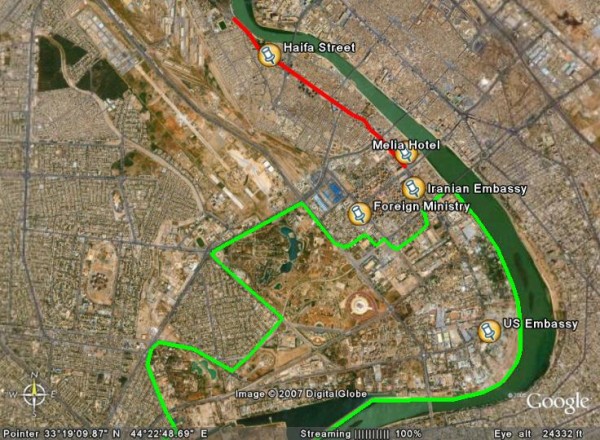
By Adel Faker
Baghdad, Jan 24, (VOI) – The Iraqi defense ministry said Iraqi army forces launched on Wednesday dawn an operation in Haifa Street during which they killed two gunmen and arrested 11 wanted persons of several nationalities. The forces also seized a large arms cache in al-Karkh preparatory school
Subscribe to:
Posts (Atom)