Wednesday, August 09, 2006

FINALLY!! THE BIG DAY -- A YEAR LATE BUT JUST IN TIME FOR ISRAEL'S ATTACK ON LEBANON


THE BAKU-TBILISI-CEYHAN (BTC) OIL PIPELINE OPENED

Ankara /13/07/ 16:23

The Bacu-Tbilisi-Ceyhan (BTC) oil pipeline, the most important regional project in Turkey's history worth $4 billion was officially opened Thursday in Turkish Mediterranean seaport of Ceyhan.

The ceremony marking the launch of the 1.770 kilometers oil pipeline carrying oil from Kazakhstan Kashagan filed in the Caspian Sea to the Mediterranean, brought together a number of senior officials, presidents of Azerbaijan and Georgia, Ilham Aliyev and Mikhail Saakashvili, nine prime ministers, four foreign ministers, as well as energy ministers and deputy-ministers of 16 countries.

"This is a historic moment that will change the world's energy map", said John Brown, the executive manager of the pipeline.

USA, the biggest supporter of the project, was represented by three energy deputy ministers - . Clay Sell, deputy secretary of energy, Matthew Bryza, deputy assistant secretary of state for European and Eurasian affairs, and Ben Sullivan, deputy secretary of economy.

The European Union was represented by Energy Commissioner Andris Piebalgs. Among attendants were also representatives of shareholder companies in the Baku-Tbilisi-Ceyhan Pipeline Consortium, including representatives of the leading shareholder British Petroleum.

$3,5 million were set apart for the oil pipeline opening ceremony.

Tight security measures included deployment of 10.000 police officers at the Adana airport located within the Incirlik Airbase and on the motorway leading to Ceyhan, where the ceremony took place.


The corridor, developed in cooperation with Azerbaijan, Georgia and the United States, aims at transporting Caucasian and central Asian oil as well as natural gas to western markets through safe alternative routes to the Turkish Straits, the Turkish foreign ministry document said.

At full capacity the pipeline will carry a million barrels of crude oil a day.

The shareholders in the BTC Company are British Petroleum (30.1%), GNKAR (25%), Unocal (8.9%), Statoil (8.71%), TPAO (6.53%, Itochu (3.4%), Amerada Hess (2.36%), ENI (5%), Conoco Phillips (2.5%), Inpex (2.5%), Total (5%).

UH OH!! THE ECONOMIC EXPEDIENCY OF THE BTC PIPELINE REMAINS QUESTIONABLE


07-12-2006 Regnum News -

Azerbaijan does not have enough oil reserves for its filling.

BTC oil pipeline is planned to transport about 50mln tons of oil annually. Otherwise, its profitability will be rather low.

It can expect producing of 20-25 million of tons by 2010. That is why, the construction’s initiators tried to persuade Kazakhstan.

However, Astana (captal of Kazakhstan) have big obligations concerning other countries, for example, China.

Several huge oil fields are being still constructed. One should not figure on supply of big Kazakhstan oil, at least in the near future.

That is why, economic expediency of BTC oil pipeline remains as usual questionable.

IT WAS THE LEFTWING BLOGBOLLAH INSURGENCY THAT DONE IT


IT'S ROOSEVELT, TRUMAN & "SCOOP" JACKSON VS. DEAN, SHEEHAN, CARTER & SHARPTON

THE VERDICT

What was once the radical left - with its antipathy toward Israel, its indifference to anti-Semitism, and its desire to appease terrorists intead of fighting them - is now emerging as part of the mainstream in the Democratic Party.

Hm, How did "Scoop" Jackson get in that list?

The Heydar Aliyev Baku-Tbilisi-Ceyhan Pipeline by Facts and Figures


Specifications

The total length of the pipeline is 1768 kilometers, of which 443 kilometers lies in Azerbaijan, 249 kilometers in Georgia and 1076 kilometers in Turkey.

The pipeline is mostly 42 inches in diameter, widening to 46 inches in Georgian and the small part of Turkish section, and narrowing to 36 inches diameter near Ceyhan.

The pipe's wall thickness ranges from 8,74 to 23,8 millimeters.

The pipeline has 8 pumping stations: two in Azerbaijan, two in Georgia and 4 in Turkey.

The pipeline’s capacity is 1 million barrels per day. It takes 10 days for crude oil to reach its final destination.

Huge oil terminals have been constructed in Sangachal, Azerbaijan and Ceyhan, Turkey.

Construction of the pipeline started in April of 2003, and its filing with oil on May 18, 2005.

The oil appeared in Georgian section of the pipeline on August 10, 2005, Turkish section on November 18, 2005, and reach Ceyhan terminal on May 28, 2006.

A total of 110 million man-hours have been worked for the construction of the pipeline.

In total, 220.000 pipes have been welded together.

Along its route the pipeline travels through 1500 rivers and 13 seismic faults.

The highest place the pipeline passes through is in Turkey at the elevation of 2800 meters above sea level.

The pipeline was buried along its entire route, and crossed 500 settlements without move of a single resident during construction activities.

Main contractors are: CCIC in Azerbaijan, Spie Petrofac in Georgia and turnkey contractors BOTAS to implement the Turkish Section of the BTC pipeline.

Planned annual capacity of the Baku-Tbilisi-Ceyhan pipeline is 50 billion tons of oil.

Over 400.000 barrels a day are transported currently by the BTC pipeline.

In 2008, the pipeline will carry 1 million barrels of oil daily

Cost and finance

Implementation of the BTC pipeline project came to 4 billion dollars. (It concerns construction activities only - the cost of the pipeline’s filling with oil, and bank interest charges are not included).

The total amount of the loans provided for the BTC project is 2.6 billion dollars. The providers are:

The International Finance Corporation (IFC) and European Bank of Reconstruction and Development (EBRD);

Export credit agencies and political risk insurance companies from 6 countries including UK, USA, Germany, Japan, France and Italy;

Fifteen commercial banks lead by ABN Amro, Citigroup, Mizuho and Societe Generale;

The companies BP, Statoil and ConocoPhillips provided loans as main sponsors.

Employment

Workforce of about 22.000, 70-80% of which locals, was involved when construction activities were in full swing. After it is put into operation, the pipeline will employ some 850 on a permanent basis.

Public Relations

450 communities (about 750.000 people) including some 100.000 landowners were registered to be affected by the pipeline along the route.

The landowners had been paid $133 million US dollars of indemnity until the end of 2003.

22.000 agreements on lease of land parcels have been signed.

A $25 million grant have been awarded for implementation of the Community Investment Program, from which 500 communities including 115 in Azerbaijan have benefited.

The program started in July 2003 will continue by the end of 2006.

In Azerbaijan, the Community Investment Program was implemented by Community Assistant Fund, International Rescue Committee, Save the Children and International Medical Co.; in Georgia Care International and Marcy Co.; in Turkey Ataturk University, SURKAL and International Blue Crescent.

32 medical units, 43 schools and 100 kilometers of roads were constructed, 314 doctors and 2.700 farmers took training courses, 184.000 people were rendered medical aid, and 15.800 micro-credits were granted under the program.

Environment

Precautionary and some additional measures to protect environment and cultural heritage were taken in the following areas along the pipeline’s route:

Borjomi National Park (Georgia)

Erzurum lowland (Turkey)

Posof (Turkey)

Ktsia-Tabatskuri Preserve (Georgia)

Gobustan cultural preserve (Azerbaijan)

The total cost of the Environment Investment Program, as well as the projects to protect turtles, black tetra fish, bears and seals, is 9 million dollars. Five million dollars were spent on archeological monitoring.

Monitoring

On behalf of creditors, a quarter-long environmental and social monitoring by the company D’Appollonia;

On behalf of creditors, 6-month social monitoring and that of the plan of land parceling, by the independent experts’ council;

A 12-month monitoring by Caspian Development Advisory Panel;

Monitoring and analysis by NGOs: In Azerbaijan by the Open Society Institute, in Turkey by TESEV through implementation of the population involvement program, in Georgia by TBC;

Human rights monitoring by Foley Hoag

BTC Co. Shareholders

BP (30,1 %); AzBTC (25 %); Shevron (8,90 %); Statoil (8,71 %); TPAO (6,53 %) ; ENİ (5 %); Total (5 %), İtochu (3,40 %); İNPEKS (2,50 %), KonokoPhillips (2,50 %) and Amerada Hess (2,36 %).

Historic milestones

September 20, 1994: signing of the Contract of the Century;

November 18, 1999: Presidents of Azerbaijan, Turkey and Georgia come together in Istanbul to sign an Agreement on transportation of crude oil through the Baku-Tbilisi-Ceyhan main export pipeline;

August of 2002: the company BTC Co. is founded in London to construct and further exploit the pipeline;

September 18, 2002: foundation stone of the Baku-Tbilisi-Ceyhan main export pipeline is laid in Baku with the Presidents of Azerbaijan, Turkey and Georgia, and US Energy Secretary in attendance;

May 25, 2005: inauguration of the Azerbaijan section of the pipeline, and filling it with the first oil in Sangachal terminal;

October of 2005: inauguration of the Georgian section of the pipeline;

May 28, 2006: Azeri oil reaches Ceyhan terminal;

June 16, 2006: Presidents Ilham Aliyev of Azerbaijan and Nursultan Nazarbayev of Kazakhstan meet in Astana to sign an agreement to encourage and create conditions for the Kazakh oil to be delivered from Kazakhstan through the Caspian Sea to Azerbaijan, and through the Baku-Tbilisi-Ceyhan main export pipeline to the world market;

June 4, 2006: first tanker filled with the Caspian oil dispatches from the port of Ceyhan to Europe;

July 13, 2006: Official inauguration of the pipeline in Ceyhan.

ISRAEL AND THE BAKU-TBILISI-CEYHAN (BTC) PIPELINE -- ANOTHER REASON TO CLEAN OUT HEZBULLOH


The recently completed 1,700-kilometer pipeline bringing crude oil from Baku, Azerbaijan through Tbilisi, Georgia to Ceyhan, Turkey is set to be officially inaugurated in a two-day ceremony starting today (Wednesday) the National Infrastructures Ministry said Tuesday.

National Infrastructures Minister Binyamin Ben-Eliezer will be included in the festivities in recognition of Israel's partnership in the BTC (Baku-Tbilisi-Ceyhan) project, the ministry said, adding that Ben-Eliezer intends to advance an "infrastructure corridor" bringing oil, electricity, water and natural gas from Ceyhan to Israel.

Azerbaijani President Ilham Aliyev supports the project to extend the BTC line to Israel, the ministry said.

PHOTO: Binyamin Ben-Eliezer

OH SHIT!!


The pipeline route passes through or near seven different war-zones


The BTC pipeline passes just 10 miles from Nagorno-Karabakh, the area of Azerbaijan occupied by Armenia, where a bloody conflict killed at least 25,000 people and created at least a million refugees.

It passes through Georgia, which remains unstable, with separatist movements in Abkhazia and South Ossetia – movements which the Georgian government tried to violently suppress during the 1990s.

Just across the border into Russia, and still only 70 miles from the BTC pipeline route, the horrific conflict in Chechnya continues. The region also saw related conflict in neighbouring Dagestan in 1999, and fighting between the Russian republics of North Ossetia and Ingushetia in 1992.

In Turkey, the BTC route passes through the edge of the area of the conflict between the Turkish state and the Kurdistan Workers Party (PKK-see 2nd map), now known as Kongra-Gel, where recently a fragile ceasefire was broken off.

[more info on these conflicts]

Due to the unresolved conflict with Armenia, Azerbaijan still keeps strong armed forces, consuming an important share of its budget. Chinese and Russian support of Armenia has led Azerbaijan to seek military co-operation with the West and Islamic countries.

Georgia’s security is threatened by its location just south of the strife-torn Russian republics, including Chechnya, Dagestan and Ingushetia, and also from within by an conflict with the separatist regions of Abkhazia and South Ossetia.

In Turkey, the PKK (Kurdistan-see 2nd map) has had a history of targeting oil installations. During the height of their armed conflict with Turkish security forces in the 1990s, the PKK identified Turkish pipelines and oil refineries in the Kurdish regions as legitimate military targets.

Meanwhile, there are clear indications of the host states’ plans to militarise the region of the pipelines system, which would carry grave risks for stability in the region and for human rights.

ANTIWAR CANDIDATE BACKS ISRAELI STRIKES -- BUSINESS AS USUAL


Ned Lamont, told the Forward that he supports Israel's current operations in Gaza and Lebanon, and that he disagreed with the European Union's declaration that criticized Israel's actions as a "disproportionate" response.

On July 22, Lamont campaigned with two Democratic members of the House of Representatives — Maxine Waters of California and Marcy Kaptur of Ohio

A willingness to campaign with Waters and Kaptur "raises a question about his commitment" to Israel, one informal adviser to the Lieberman campaign told the Forward... "embracing two noted opponents of Israel, then he must share their views, and it's up to him to tell us that's not so, and why he is embracing them."

In response, Lamont said, "I've been very clear from the get-go that [I'm] a supporter of Israel."

In his interview with the Forward, Lamont said that he did not agree with calls for an immediate, unconditional cease-fire between Israel and Hezbollah.

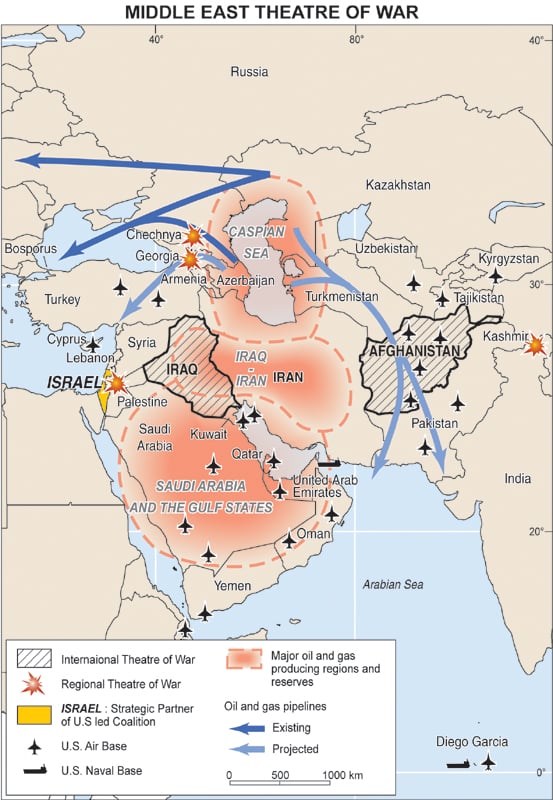
MIDDLE EAST THEATRE OF WAR


© Map by Eric Waddell, Global Research, 2003.
(click on map to enlarge)

KURDISTAN (ON THE BTC PIPELINE)


...violence along the border of Turkey and Iraq between Kurdish separatists and the Turkish armed forces.

Intensified attacks by Kurdish separatists are putting increased pressure on the Turkish government to strike at rebel bases in Iraq.

Washington has warned Turkey to refrain from any cross-border action, but diplomats say Turkish Prime Minister Recep Tayyip Erdogan has replied that Kurdish violence "has gone beyond the limits of tolerance."

The difficulty today emerges because, as Seymour Hersch reported years ago, the Kurds in Northern Iraq (Kurdistan Workers Party, known by its acronym, PKK) are closely alligned with Apartheid Israel (but this is more about shipping oil from Kirkuk to Haifa and an wedge against the Sunni Insurgency).

The combination of continually brazen attacks against Turks by Kurds from Iraq and the appointment of the ruthlessly anti-Kurd Buyukanit as commander of the Turkish military probably means...

PHOTO: Kurdish rebel leader Abdullah (Apo) Ocalan

Rest of article here

Tuesday, August 08, 2006

One of Olmert's closest aides is on the record as saying that the Palestinians must be put on a "diet:...make them hungry ...


Dov Weissglass, an adviser to Israel’s prime minister, summing up its strategy after the Hamas election win, said the Palestinians should be ‘put on a diet but not starved to death’. They will be punished for practising democracy, and both the United States and the European Union endorse that punishment. Western double-talk about democracy and justice has provoked outrage in Muslim countries and encouraged resistance to foreign intervention.

By Georges Corm

Completely controlled by Israeli military forces, the borders of the Gaza Strip resemble prison walls and gates around this crowded and undernourished strip of land along the Mediterranean Sea. The coastlines themselves are also tightly controlled, so that in most parts of Gaza, children spend their entire lives growing up within view of the sea, but unable to access it.

Israeli authorities appeared unconcerned about the severe shortage of food in the Gaza Strip. Top advisor to the Israeli prime minister, Dov Weisglass, said recently that Palestinians should be `put on a diet`, referring to the imposition of sanctions on the population as punishment for voting for the Hamas party in January`s democratic election. Despite the fact that the United Nations has condemned the closure, and noted that 40% of children in the Gaza Strip suffer from malnutrition, Israeli politicians seem entirely unconcerned with the fate of the 1.2 million Gaza Palestinians -- a fate that is, at this point, entirely in their hands.

Top Photo: Prime Minister Olmert
2nd and 3rd Photos: Dov Weissglass

// posted by needingsugar @ 10:57 PM

THE JOURNEY OF A MAN FROM A CHURCH THAT EVOLVED FROM SIMPLE FUNDAMENTALISM TO "CHRISTIAN-ZIONISM"


This post of found on the excellent blog Spontaneous Arising, courtesy of comment blog Moon of Alabama

"It's late and I really do not want to do this so we'll ask you bear with the typos. I'm tired and I just found this remarkable thread here.

The rapture mentality in America has been associated with the establishment of Israel in 1948. That was the sign, Luke 21:29-30, the flowering of the fig tree (a symbol for Israel) is a sign of the end and the second coming. A host of book, all bad, since Hal Lindsay's Late Great Planet Earth lit a fire in the emerging Jesus movement of the 1970's that lent it a true apocalyptic fever. add to this the continual risk of nuclear war and the expectation of the near time of the end became foundational in Pentecostals, Evangelicals and Fundamentalists and to a lesser extent, the Catholic Charismatic movement.

But throughout the the 1970's, this movement, despite the frequent appearances of Billy Graham with Nixon and Ford was primarily apolitical. The message was Christ and him crucified and in many cases a radical distrust of the "world". It was apolitical, with Democrats rejected for their liberalism, pro-abortion stance, and pro-education platform. "Secular humanism and Communism" were the enimies. But neither did these Christian embrace the Republican party, with its cold fish corporate elitism, immense wealth and corporate amorality and their reputation for pragmatism and agnosticism. All these identified both parties with being of the world and the big issue many of these Christians felt was whether they should vote at all. Many felt that their faith would be compromised if they became politically active or ran for office. To guard against the seduction of the world was a key goal. Many joked when a candidate for either party claimed to be a christina becuase the Christians of this movement and period were usually savvy enough to know that the key elements of their faith would have to be compromised to be a success in Washington. But this was to change.

It started in the late 1970's and the early 1980's, both with the first advent of Falwell's "Moral Majority" and the election of Ronald Reagan. Perhaps it was Lee Atwater, perhaps it was simply a situation the evolved from the emerging power when leaders of a revival that has lasted a decade realized that controlling a large number of people equaled power, maybe it was now that the money and influence Sun Myung Moon began to assert its seduction in Christian leadership. But it appears that several movements and events developed simultaneously and it changed the face of American Christiainty.

First many individual in the Catholic Charismatic movement left the Catholic Church and join or started independent Pentecostal and Charismatic churches. They brought with them a loud tradition of anti-abortion activism that was now coupled with charismatic prophetic rleigion. Traditional Pentecostal churches had little interest in the issue, but with the numbers of new Charisimatic churches and the advent of a number of parachurch organizations, it slowly became more central issue.

At the same time, a movement swept across churches all over the United states from Oklahoma and Texas. This was the start of the popularization of the health and wealth gospel, a large auxillary church movement that preached that God wanted Christians to be healthy and wealthy and the lack, poverty, and sickness were a curse from Satan that can be overcome by faith in key Scripture Verses expressed vocally and frequently (also called confession faith). this caught the interest of politcal conservative as wealth tended to resonate with their values. Parachurch organizations began having large inter-church meetings by the mid-1980's full of celebrities and high ranking military retirees claiming conversion. In one meeting I attended, just to give you the variety of people attending, I ran into Pat Boone, Debbie Boone, Richard Kiel (Jaws from James Bond) John DeLorean, Gen. Merle Allender, Tonto, Buffalo Bill's Grandson, Dale Evans and more.

The next development was the advent of the Megachurch, starting in Oklahome, Texas and Florida. Many of these and their imitations fell apart, but they continue to be a major feature. Church of 4,000 were common by the late 70's, and frew even stronger into the 80's. Now some of these church claim memberships in the tens of thousands and have created a cradle to grave experience for believers with everything from pre-schools to universities to profesional associations. the money these churches can raise in a week is staggering.

Finally, another development was the intentional steering this diverse movement into the arms of ultraright conservatism. This started in the early years of Reagan's first term and was both deliberate and calculated to politicize the church. I remember my first experience with this very well.

I was young and a member of a Jesus Movement church (think hippies) whose main mission was to help local junkies kick heroin and preach to young people. But it was a sincere group. It started as a home church in my parents house, grew to require the rental of an second floor office in a bad part of town, and finally, we rented space for 300 people to worship at Yale University. For several years, it was the most remarkable group I ever participated in. It was quite diverse: Blacks, hispanics, lesbian, homosexuals and street people came every week. But there were also blue collar workers, professionals, college students, medical students who worshipped together and had a sense of community I have never experienced since. I am not being completely nostalgic. There were many problems in this church. It was doctrinally naive, the leaders were young and uneducated, and focus of the message kept changing, mainly due to the pastor's immaturity and youth.

But in 1982, the pastor was invited to a Ronald Reagan Prayer Breakfast, something that flattered him immensely. He went. when he returned, the church was turned upside down. His next sermon mentioned "Satan's Liberal Welfare State," the evils of the "radical hairy legged lesbo-feminist of the Democratic Party," calls for the judgement of God upon homosexuals and the wrath of the Jesus church against lazy people who did not work and ripped off honest taxpayer by being poor and on welfare." The church changed. the non-white, non-rich, non-straight, and non-loyal (myself) left or were humiliated and driven off (someday I'll tell you about my personal five hour degregation ceremony). The church and many like it made a sharp turn to the right, ready to purge America of sinners and homosexuals and evil abortion doctors and liberal secular humanists. My world was shattered.

I rarely share with anyone the torment of the next few years, the inner doubts, the depression, the tension (this was my family's church and they split apart, many not talking to one another for years). Three churches later, a good pastor spent a long time with me and began to help me find those parts of myself I long suppressed. I ended up going back to school in my early 30's a double major in history and theology with a concentration in linguistics. I excelled. I then went to grad school and continued in Roman Social History and Early Church History. I'm now a decade post doc, tenured at a sane secular school! I could have gone to Yale, but I had nothing but painful memories in New Haven.

I keep most of this to myself in my new life. I attend a happy church of the religious left and have peace. And I spend much of my time looking at the phenomenom of the politically hijacking of the church by the ultrarightist. It is a fascinating story. This is only a very brief synopsis, but I thought I'd share this small bit of it. But I'm tired, its last call at the bar, and I'm slugging one down and hitting the sheets. Every try a Rum and Moxie?

Posted by: Diogenes | Aug 7, 2006 11:58:04 PM | 21

PHOTOS: Hal Lindsey in Jerusalem, Billy Graham, Jerry Falwell, Lee Atwater, Sun Myung Moon, Falwell & Moon, Pat Boone, Dale Evans, Ronald Reagan, Hagee/?/Gary Bauer/Falwell, John Hagee

HALF OF U.S. STILL BELIEVE THAT IRAQ HAD WEAPONS OF MASS DESTRUCTION


DATE OF PHOTO: Friday July 21, 2006 at 8:07 PM EST

JUST IN CASE YOU HAVE BEEN LOOKING FOR A GRAND UNIFIED THEORY OF THE M.E. AND THE NEWS IS TOO COMPLICATED FOR YOU


You are on God's "Outline of History" just barely to the left of the "green arrow" labeled rapture and pointing upwards. I would suggest that you get on the phone to Hal Lindsey and purchase your ticket.


Photos originally found at Spontaneous Arising

ADDING A LITTLE SMOKE WON'T CHANGE WHAT'S ON THE GROUND...


...BUT IT IS VERY USEFUL IN BLOWING A LITTLE SMOKE UP THE ASS OF AMERICAN PUBLIC OPINION